. Skip to main content
man fighting clock daylight saving time

Should we still follow daylight saving time? Photo: iStock

Why Do We Have Daylight Saving Time, and Should We Keep It?

November 4, 2022

Why Do We Have Daylight Saving Time, and Should We Keep It?

Why do we change our clocks twice a year? Help high school students explore daylight saving time’s history, health effects and ongoing debate with videos, an NPR interview, maps and discussion questions.

Share

Share On Facebook
Share On Twitter
Share On Pinterest
Share On LinkedIn
Email

Updated October 2026: We’ve refreshed this lesson with new context on the daylight saving time debate, clearer discussion questions and optional classroom activities. The original 2022 reporting and NPR interview remain for historical context.

What Is Daylight Saving Time?

Twice a year, most Americans change their clocks, springing forward in March and falling back in November. But why do we still do it? Daylight saving time (DST) has been around for more than a century, yet Americans continue to debate whether it's worth keeping. According to a 2026 YouGov survey, 64 percent of Americans would prefer to stop changing their clocks twice a year. But that raises another question: Should we make daylight saving time permanent, or would sticking with standard time be better for our health and daily lives?

Check out the videos, podcast and discussion questions below to explore the history of daylight saving time, bust some common myths, learn how changing the clocks affects our health, and discover why a country as large as China uses just one time zone.

Remote video URL

Discussion: So Why Do We Have Daylight Saving Time?

Note: This WBZ report aired in 2022, when the Sunshine Protection Act had passed the Senate. A newer version passed the House in July 2026 but has not become law.

  • What common myth about daylight saving time does the report challenge? Why did farmers oppose it?
  • Why did countries begin using daylight saving time during World War I?
  • Do you think daylight saving time still serves its original purpose? Why or why not?

Optional Extension: Daylight Saving Time Mythbusters

Before watching the video, have students vote on whether each statement is true, false or needs more evidence.

  1. Daylight saving time was invented to help farmers.
  2. Benjamin Franklin invented daylight saving time.
  3. Daylight saving time saves energy today.

After watching, revisit the statements as a class. Which answers changed? What evidence does the report provide, and which claims need additional research?

Take it further: Challenge students to investigate one claim using a historical document or scientific source. Can they find evidence that supports or challenges what they heard?

American Voices

Did Benjamin Franklin really invent daylight saving time? Not exactly! In 1784, Franklin wrote a satirical essay suggesting that Parisians could save money on candles by waking up earlier and making better use of sunlight. He never proposed changing the clocks. Have students read his original essay and consider: How does Franklin use humor to make his argument, and which of his suggestions are meant to be taken seriously?

Fast Facts: Frustrated Farmers and Happy Retailers

Did you know that farmers were among the strongest opponents of daylight saving time when the United States first adopted it in 1918? Many argued that the change disrupted their daily routines, which depended more on sunlight than the clock. Here are a few reasons why:

But here's an interesting twist! In 2026, the American Farm Bureau Federation expressed support for permanent daylight saving time, arguing that a consistent, year-round schedule could make life easier for farmers and rural businesses.

So who else benefits from daylight saving time?

Retailers have historically supported daylight saving time because later sunsets can encourage people to shop and enjoy outdoor activities after work. But whether daylight saving time actually saves energy is another question. A U.S. Department of Energy study found that extending daylight saving time in 2007 produced only modest electricity savings, with no measurable effect on gasoline consumption.

Listen: Daylight Saving Time and Health Effects

Note: This NPR interview originally aired in March 2022. The discussion of the Sunshine Protection Act reflects the legislation's status at that time, but the questions about sleep, health and changing the clocks remain relevant today.

Discussion Questions

  • What health and safety risks does Dr. Johnson link to changing the clocks in spring?
  • Why does Dr. Johnson believe permanent standard time would be better for our health?
  • If the U.S. stopped changing clocks twice a year, would you prefer permanent daylight saving time or permanent standard time? Why?

Optional Extension: The Great Time Debate

  • Should the United States adopt permanent daylight saving time or permanent standard time?
  • Imagine you're speaking before lawmakers who are considering changing the country's clocks for good.
  • Working in pairs, prepare a 60-second argument supporting one option. Use at least one point from Dr. Johnson's interview, and consider how your choice might affect students, families and working people.
  • Invite a few pairs to share their arguments. Then take a class vote. Which arguments were most convincing, and did anyone change their mind?

What Does Your State Think About Daylight Saving Time?

Did you know that 19 states have passed legislation supporting permanent daylight saving time? According to the National Conference of State Legislatures, these laws cannot take effect unless federal law changes. States can already choose to observe standard time year-round, but they cannot independently make daylight saving time permanent. Check out the NCSL's state legislation tracker to see what lawmakers in your state have proposed.

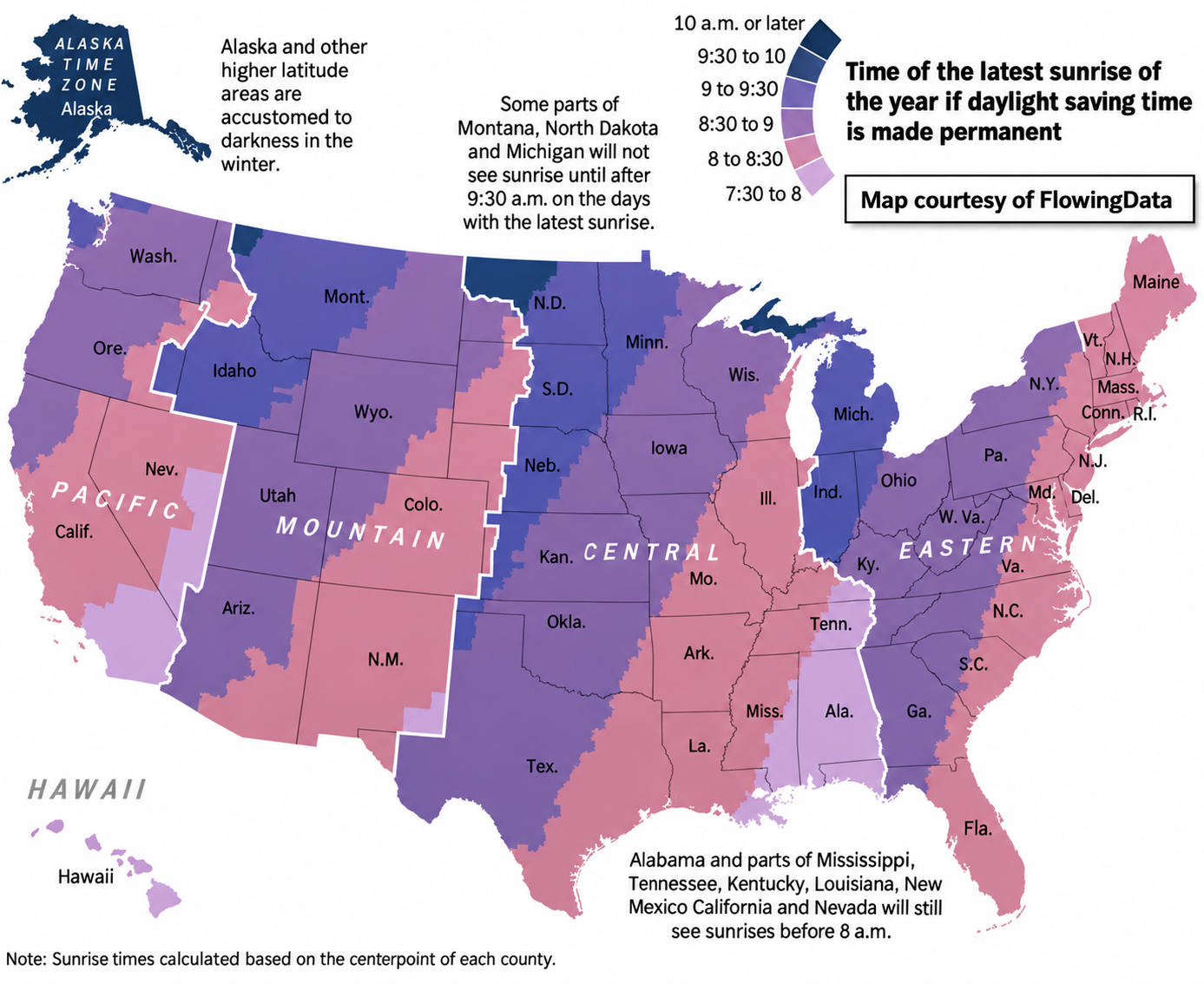
But what would permanent daylight saving time actually look like where you live? Take a look at the map below, originally published by The Washington Post. It shows how late the sun could rise on the darkest winter mornings if daylight saving time became permanent. In some parts of Montana, North Dakota and Michigan, sunrise wouldn't happen until after 9:30 a.m.!

Color-coded map of the United States showing the latest sunrise times of the year if daylight saving time became permanent. Sunrise times range from 7:30 a.m. to 10 a.m. or later, with parts of Montana, North Dakota and Michigan experiencing sunrises after 9:30 a.m.
Map credit: Justin Grieser, Joe Fox and Tim Meko / The Washington Post (2022), via FlowingData.

Explore the Map

  • According to the map, which parts of the United States would experience the latest winter sunrises under permanent daylight saving time?
  • What differences do you notice between sunrise times in the eastern and western parts of the same time zone?
  • How might a winter sunrise after 9 a.m. affect students and families?

Optional Extension: You're on the School Board!

  • Imagine your school begins at 8 a.m., but under permanent daylight saving time, the sun wouldn't rise until after 9 a.m.
  • Working in pairs, come up with one change your school could make to address this challenge. Consider school schedules, transportation or student safety.
  • Have each pair share its recommendation and explain one possible drawback. Then vote as a class on which solution seems most practical.

In Pursuit of Unity: Why China Has One Time Zone

Imagine if it were 7 a.m. in both New York City and Los Angeles. That's essentially how China's official clocks work! Despite stretching across roughly the same distance as the continental United States, China uses just one official time zone, known as Beijing Time. In 1949, the country began transitioning from five time zones to one, partly to promote national unity. Watch the National Geographic video below and consider how a single time zone might make life easier for some communities while creating challenges for others.

Remote video URL

Key Terms

  • Nation-building: Efforts to create a shared national identity and strengthen unity among people within a country. Governments may promote common symbols, institutions or policies, such as China's decision to adopt a single official time zone.
  • Time zone: A geographic region that follows the same official clock time. Time zones help communities coordinate daily activities, but their boundaries don't always follow geographic lines.
  • Standard time: The official clock time used in a region when daylight saving time is not in effect. Some places, including Hawaii and most of Arizona, observe standard time year-round.

Discussion Questions

  • Why did China decide to adopt one official time zone in 1949?
  • How does using Beijing Time affect daily life in western China?
  • What do you think is the biggest advantage or disadvantage of having just one time zone for an entire country?

Optional Extension: One Country, One Clock?

  • Explore this interactive population density map and compare where people live in China and the United States.
  • Notice where populations are most concentrated and where fewer people live.
  • Your challenge: Imagine you're advising China's government. Based on what you learned from the video and the population map, would you recommend keeping one official time zone or adopting several?
  • Share your recommendation with a partner and use one observation from the map to support your reasoning.

newsletter sign up

Andy Kratochvil
Andy Kratochvil is a proud member of the AFT Share My Lesson team, where he’s passionate about discovering and sharing top-tier content with educators across the country. He earned his bachelor’s degree in political science and French from California State University, Fullerton, and later completed... See More
Advertisement

Post a comment

Log in or sign up to post a comment.